Rice, cooking oil, African print textiles, beef, and other food products have all seen price increases as some dealers have capitalized on the nation’s Muslims’ celebration of Eid ul-Fitr.
Last Tuesday and Wednesday, The Media visited the Makola and Madina markets in Accra and found that the pricing of the products had gone up in the previous week.
The dealers pointed out that currency devaluation, which was once a significant influence, has been stable for some time and blamed the hikes mostly on rising demand and shipping expenses.
A five-kilogram bag of Lele rice, which was selling for GH¢175 a week ago, is now selling for GH¢215, according to Amanda Yaovi, a dealer at the Makola Market, who spoke to this reporter.
Likewise, the price of a 4.5-liter bottle of Frytol frying oil increased from GH¢00 to GH¢250, although she stated that the price may be lowered to GH¢240.
As businesswomen, we had to take advantage of the season to make some sales, she joked, adding that “as usual, prices will go down after the festivities.”
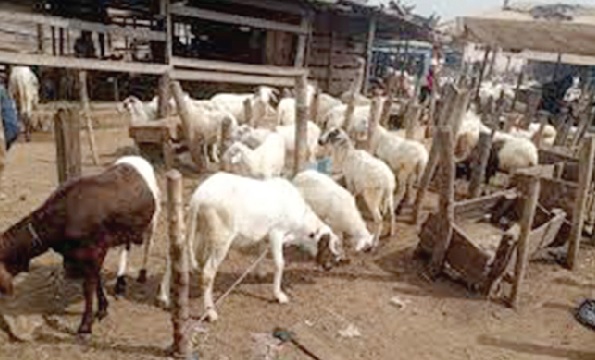
The prices of these animals ranged from GH¢1,200 to GH¢25,000.
While defending the rates, another merchant, Aisha Suleiman, who was a few meters away, stated, “sometimes, the entire month, you may not be able to make your desired sales, so times like these help us catch up; then we can restock.”
Subsequent investigations showed that the price of live animals, especially poultry, goats, and cows, had increased.
A broiler that previously to cost between GH¢150 and GH¢350 is now sold for between GH¢230 and GH¢380 at a poultry stand within the Madina market near the overhead bridge.
It’s not always our fault. Our workload increases as demand rises, therefore we have to raise prices to keep up,” Danfo, an attendant, clarified.
Similarly, goats and cows ranged in price from GH¢1,200 to GH¢25,000.
Another place where prices increased was Accra’s African print markets at Makola and Kingsway.
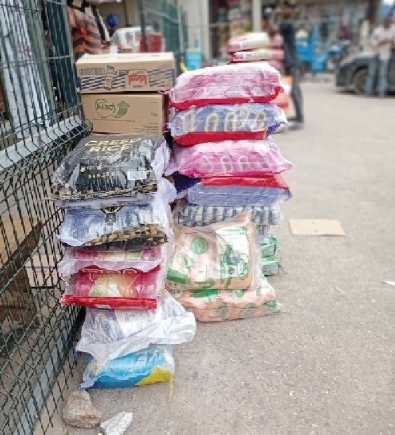
A main food during the celebrations of Eid ul-Fitr is rice.
Some traders claim that the chief porters, known locally as “Kayayei,” who usually traveled to their hometowns for the celebrations, were their primary clients.
“If you know Muslims, you’ll know that a major component of their Sallah celebrations is wearing fresh, vibrant apparel. To sew their clothes, they save money and then purchase four yards or more of Hitarget, Woodin, or the less expensive Chinese fabrics, according to fabric seller Madam Araba Rita.
“We also have to take advantage of the season and make some profit, but sometimes when their monies are not up to, we offer small discounts,” Dorothy, another merchant, clarified.
A week ago, fabrics like Hitarget and Woodin cost GH¢75 per yard; Chinese-made fabrics and imitations, which were frequently unbranded, cost GH¢20 to GH¢35 per yard, representing an increase of roughly GH¢6. The price increases were not consistent across all markets, as some vendors kept their prices the same while others gave discounts on products that were about to expire. At the Yesu Mo provision shop in Madina, the costs of food items like tomato paste, rice, seasoning, spaghetti, and tuna flakes remained the same.
Mrs. Gladys Essuman, the store owner, stated, “I want to get rid of my inventory, and I also don’t think it’s fair to raise prices just because it’s the season.”
She questioned, “Why raise my prices when I still make a profit at my current prices?”
In the fashion market, secondhand dealers and vendors of ready-made garments, which are mostly imported from Turkey, Burkina Faso, and Togo, reported higher sales and profit margins during the two weeks preceding Eid.
“Period wei diɛ, ɛtisɛ Christmas anaa sɛ Easter for yɛn Moslem friends’ nu ɛnti ɛyaa omo tɔ adiɛ paaa,” stated Mr. Isaiah Kokuvi Dorkenu, a shoe vendor in Makola.
That is to say, our Muslim friends shop a lot during this time, which is similar to Christmas or Easter.
Another vendor who identified himself as Foster stated, “The women concentrate on clothes and heels, while the men primarily buy jeans, shoes, and jewelry for the celebrations.”
Consumers
Many customers stated in separate interviews that they were not shocked because this occurs annually.
Due to Ghana’s custom of price rises during celebrations, I had already budgeted for the price increases. Miss Fadila Abdul Basit stated, “I knew the prices would increase, so I bought the main items I wanted, like a new wig and abaya, about a month ago.”
She went on to say that in order to adapt, she had also modified her spending patterns.
“I only buy one or two things I need for the celebration, rather than a lot of things.”
It was a stressful scenario for four-time mother Fatima Mohammed.
Normally, my spouse and I purchase new clothing, shoes, and presents for our kids, but this year we had to make some sacrifices. We won’t purchase much. Furthermore, we would prefer to spend it on the “big Eid” in September because this is the “small Eid.”
The same worry was voiced by Mr. Baba Osama. Since his family had not planned a lavish party, he was not very concerned about the price increase.
He declared, “We won’t be buying too much, but I’ll get what we need regardless of the price.”
visit itrotronews everyday for updates