Conclave, the procedure for selecting a new pope, usually occurs 15–20 days following the passing of a pope.
In a video message released Monday morning, the Vatican confirmed the death of Pope Francis. Francis was elected pope in 2013, and due to his health, he had to reschedule various engagements in recent years, often at the last minute.
Rome’s Bishop
Following the resignation of Benedict XVI, the pontiff, who was also the leader of the Catholic Church and the Bishop of Rome, was elected pope in 2013.
Francis spent 38 days in the hospital in February and March of this year after a series of health issues in previous years.
However, he made enough progress to be discharged from the hospital and was only yesterday interacting with Easter Sunday throngs in St. Peter’s Square.
Conclave, the procedure for selecting a new pope, usually occurs 15–20 days following the passing of a pope.
Recent trips to the hospital
His pontificate has been characterized by many hospital stays and health-related worries in recent years.
The Pope was treated for bronchitis after being brought to the hospital on February 14.
Following tests that showed he had low platelet levels in his blood, which are linked to anemia, the Vatican announced he had been diagnosed with bilateral pneumonia and had received blood transfusions.
next a “prolonged respiratory crisis” that necessitated a high flow of oxygen, the Vatican said on February 22 that Francis was in serious condition. The next day, the Vatican reported that Francis was exhibiting “initial, mild” renal failure.
In the days that followed, hundreds of worshippers flocked to St. Peter’s Square to offer prayers for his recovery, while others visited the hospital in Rome where he was being treated to deliver cards and flowers.
Doctors said his health remained “complex” and he spent the remainder of the month in the hospital.
For the first time since his hospital admission, his voice could be heard in an audio message on March 6. He greeted well-wishers and then said, “I am with you from here.”
One day after meeting US Vice President JD Vance, he spoke to large crowds at the Easter Sunday Service on Sunday.
On March 23, he made his first public appearance in five weeks, grinning and giving the spectators outside a thumbs up as he concluded his 38-day hospital stint on a balcony at Gemelli.
Before starting two months of recommended rest and recuperation, Pope made a surprise stop at his favorite church on his way back to the Vatican.
The pontiff would continue to take oral medication for a considerable amount of time to treat the fungal infection in his lungs and to continue his respiratory and physical physiotherapy, according to the doctors, who also stated that Francis would have access to additional oxygen and round-the-clock medical care as needed.
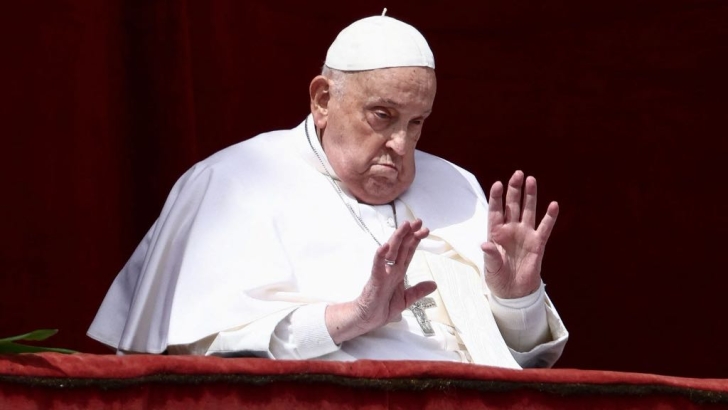
During Easter festivities at St. Peter’s square in the Vatican on April 20, 2025, Pope Francis stands on the main balcony of St. Peter’s basilica for the Urbi et Orbi speech and blessing to the city and the globe.
“Pope of the People”
Francis, the first pope from South America, was born in 1936. He was known as the “People’s Pope” because of his support of individuals fleeing poverty, famine, and conflict during his pontificate.
He performed a “gesture of humility and service” in 2016 by washing the feet of migrants of various faiths at an asylum center outside of Rome.
He has expressed his opinions on a variety of topics, including the role of women in the Catholic Church, financial inequality, and climate change.
He made an unexpected comment regarding homosexual clergy to reporters on a trip returning from Brazil, which marked the beginning of his exceptional acceptance of the LGBTQ community.
He stated: “If a person is gay and seeks God and has good will, who am I to judge them?”
However, by signing the document “Dignitas Infinita” (Infinite Dignity) in April 2024, he seemed to reaffirm the Vatican’s strong opposition to gender reassignment, surrogacy, abortion, and euthanasia.
His own liberal credentials were called into doubt the same year following allegations that he had used a homophobic slur in private.
Pope’s latest state of health
Francis had a portion of one lung removed when he was a young man in his native Argentina.
Francis struggled with illness and bronchitis in his latter years, limiting his public speaking and using a wheelchair or cane to move around.
In 2021, Francis was admitted to the hospital for the first time as pope in order to have a portion of his colon removed.
He was brought to the hospital in June 2023 for an intestinal procedure. He had been experiencing “recurrent, painful and worsening” symptoms, according to the Vatican at the time, which were attributed to an abdominal hernia.
Due of his recent health problems, Francis was unable to attend important Roman Catholic holidays, like as last year’s customary Good Friday procession at Rome’s Colosseum.
He made a suggestion in 2022 that he would resign if his health worsened after being seen in a wheelchair in 2022 because of movement problems brought on by a flare-up of sciatica, a nerve disorder that causes pain in the legs.
Instead of serving for life, his predecessor, the late Benedict XVI, became the first pope to step down in almost 600 years in 2013, and he passed away in 2022.
Jorge Mario Bergoglio was the Pope’s first name, and he had previously been a Buenos Aires bishop.
Francis’ death will be mourned by an estimated 1.4 billion Catholics worldwide.
visit itrotronews for everyday updates