She discovered she couldn’t read the chalkboard well when she was 10 years old and in primary 6. A concerning circumstance that led to several hospital visits and various eye treatment procedures as she grew older until she eventually lost her sight at the age of 30.
Retinal dystrophy, a hereditary eye disorder that gradually reduces eyesight, was the source of her visual impairment.
She faced several challenges that may have stopped her from completing her school and following her goals even before she lost her sight entirely. But she choose a different route because of her tenacity, her trust in God, and the encouragement of her family and few close friends.
The 67-year-old mother of three, Mrs. Gertrude Oforiwa Fefoame, was the UNCRPD’s immediate past chair. She is also Sightsavers’ global advocacy manager for social inclusion, global president of the International Council for Education of People with Visual Impairment, and commissioner of the World Council of Churches.
She was the UNCRPD’s most recent chair.
She has achieved several firsts, both in Ghana and elsewhere. She is the first African woman elected to chair the UNCRPD, the first African elected to be the International Council of People with Visual Impairment’s Global President, and the first person with visual impairments to receive master’s degrees from the Akrofi-Christaller Institute of Theology, Mission, and Culture and the Ghana Institute of Management and Public Administration.
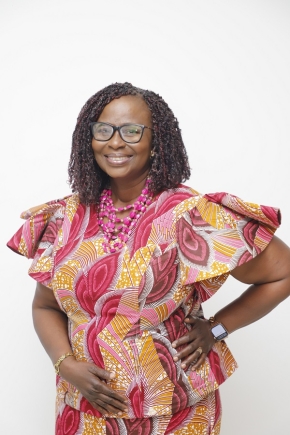
She has led and volunteered for many organizations and groups that support gender and disability issues for more than 40 years.
A depressing experience
When The Mirror interviewed her at her Accra office last Tuesday, she described how some distant relatives had confronted her with sad remarks after learning that she had been enrolled at the School for the Blind, Akropong-Akuapem, after finishing Form Five.
I changed my glasses many times by the time I was fourteen, and even with them on, I was unable to read all of the textbooks. I had a restricted reading ability while I was in Form Two, which was between the ages of 14 and 17. I was unable to read, therefore I relied on relatives at home and friends during study sessions. I completed Form Five that way. I selected the science option since I found reading difficult, not realizing that the practical sessions would be more difficult. I recall an activity where we had to cut a cockroach’s thigh, sketch it, and identify it. I couldn’t see the colors during chemistry,” she said.
She said that she would not have taken her Form Five final test if it weren’t for a teacher who offered her hand lenses, which magnified her prints, after she had to miss weeks of school on many occasions for medical care.
She received two credits, two passes, and two failures when the results were announced. She should enroll at the School for the Blind to study braille reading and typing, according to one of her uncles.
“I have family in Akropong because I was born and raised there for a few years. The traditional inhabitants, including my distant ancestors, dubbed me “Ohemea Foriwaa” since I was named after the town’s queenmother.
Three of the women who knew me stopped by the side of the road one day and inquired as to why I was there. They started crying when I revealed that I was a student there. They said things that I don’t want to remember, such, “They thought I had a bright future.” She recounted, “I left them feeling hopeless and crying.”
Turn around.
Aunty Getty, as she is usually known, claimed that although she worried about the women’s remarks for the next several days, she was also determined to disprove them and that God had given her someone in time to help.
One of the professors who oversaw her oral English test at the Ghana Secondary School, who was unaware of her difficulty, observed it and brought it up with his pupils at Wenchi Secondary School, one of the first secondary schools in Ghana to accept students with visual impairments.
“This young woman, the late Ms. Grace Preko, wishes she had met me after being moved by her teacher’s narration. It was challenging back then, and because I had finished school, she was unable to get in touch with me through the school, unlike now when we can simply connect over the phone.
Fortunately, Grace learned that someone who had finished secondary school had been accepted to the School for the Blind when she registered at the Teacher’s Training College in Akropong. She came to check up only to find I was the same person her instructor spoke about.”
“I can still picture her in my mind; she was fair, had plaited hair, was articulate, and was tidy. She became a buddy who had a good understanding of blindness. I admired her and wanted to become a teacher as well.
After a year at the School for the Blind, I applied to and was accepted into the Teacher’s Training College. Grace was really helpful; she showed me how to record lectures on cassettes and, as we were studying common subjects, she had recordings of some of them already,” she recalled.
Advocacy
After graduating from Presbyterian Training College in May 1979 with a Post-Secondary Teacher’s Certificate, Mrs. Fefoame began her academic career and subsequently became an advocate for people with disabilities.
She continued on to earn a Bachelor of Education (Special Education) from the University College of Education, two master’s degrees, a Diploma in Special Education from the College of Special Education, and several additional courses from worldwide organizations.
There were numerous obstacles to overcome while attending these several schools as a visually impaired person, but she was encouraged by her will to achieve and the openness of certain administrators to meet her requirements.
She began her advocacy work as a volunteer for the Ghana Association for the Blind before moving on to teach in special education and regular schools.
Over the years, she has spearheaded several policy, program, and capacity-building initiatives in social development and has been a highly prominent local, national, and worldwide advocate for people with disabilities.
She is appreciative of her family, mentors, and husband, Mr. John Vital Fefoame, who have supported her through it all.
She acknowledged that it was difficult to raise children as a visually impaired mother since there were times when she was unable to determine whether her kids were in danger.
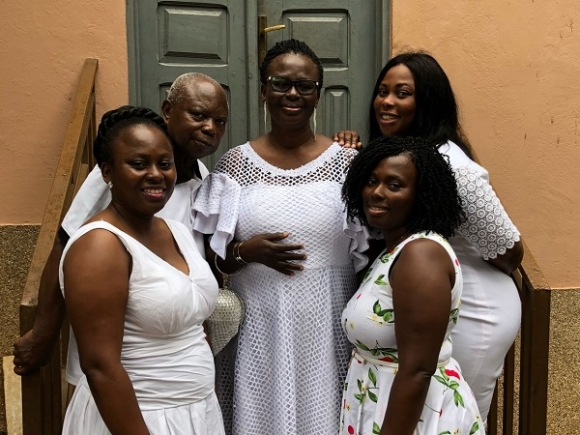
Mrs Fefoame, (middle) with her husband, Mr John Vital Fefoame and their three daughters. They are Euget Zevi Motogbe, (left) Eunice Diede Fefoame (right) and Eugenia Nibie Fefoame
Her schedule required her to travel frequently and accompany her to many of her overseas jobs, so she was especially appreciative to her husband, who had frequently stepped in to look after the family (when the kids were little).
Mrs. Fefoame remains a champion for accessibility for people with disabilities in the areas of environment, information, communication, and transportation.
“We don’t follow the accessibility guidelines that we and the government have created, which include slopes and guidelines for the construction of bumps. “We want an environment that makes life easier for people with disabilities, including braille displays and sign language interpreters,” she stated.
Email address of the writer: efiaamoakoa2@gmail.com
visit itrotronews everyday for updates