According to John Eric Kwofie, the Central Regional Manager of Ghana Water Limited (GWL), the total amount of unpaid arrears owed to the corporation in the region is an astounding GH₵69,517,644.05.
He voiced serious concerns that the company’s capacity to function effectively was being severely hampered by the accumulation of these debts, which would have an impact on service delivery and the region’s overall water supply sustainability.
Speaking at a World Water Day media event last Friday with the topic “Water Conservation: Let’s Make It Our Way of Life,” Mr. Kwofie emphasized how vital it is that clients fulfill their financial commitments to the business.
He claimed that the inability to pay the arrears had put a great deal of strain on the GWL, making it more challenging to maintain infrastructure, pay employees, buy necessary chemicals for water treatment, and start new initiatives to enhance service delivery.
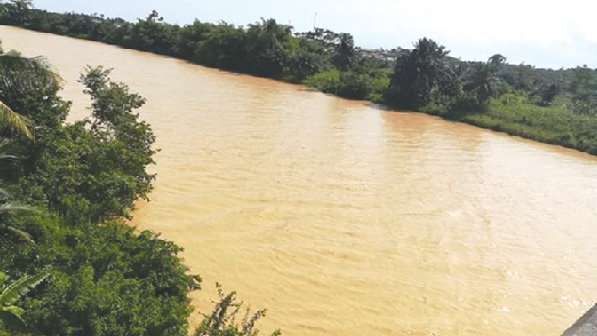
Illegal mining operations in the Central Region that have an impact on water bodies
He urged everyone in debt to pay their debts on time, pointing out that the defaulters included individual organizations, businesses, and entire towns.
E-payment system and paperless billing
Mr. Kwofie declared that the GWL had completely switched to a paperless billing system in order to increase productivity and lessen the strain of bill payments.
According to him, the company has implemented an electronic billing platform as part of this project, which enables consumers to conveniently pay their bills by dialing *1010# on all networks.
Customers no longer have to waste time and money traveling to the GWL offices in order to pay their bills thanks to this new electronic payment system. Payments may now be made at any time and from any location,” he said, adding that the digital shift would significantly increase revenue collection and service effectiveness.
He urged the people to cooperate and use water responsibly, and he reaffirmed the GWL’s commitment to enhancing service delivery.
Illegal connections
The company lost about 20% of its revenue due to illegal water connections, according to Nicholas Okyere, Regional Water Quality Assurance Manager. He also expressed concern about meter tampering, which is when people tamper with meters to avoid accurate billing, and the fact that some customers had turned to stealing the company’s water meters, which made it hard for the company to monitor consumption and enforce payments.
He cautioned that the company’s capacity to keep a steady and dependable water supply was being severely strained by such operations.
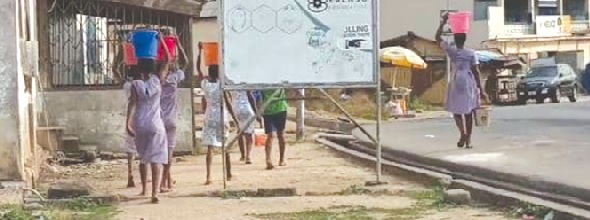
There are times when both young and old must look for water.
He said that in order to combat this threat, the GWL had implemented a system of rewards to incentivize the public to report instances of water and meter theft.
This program would reward those who report instances of illicit connections or meter tampering, which would result in the arrest of the offenders.
“Water theft is a significant issue that impacts not only the business but also law-abiding clients who depend on us for a steady supply. He urged the public to help us combat this problem by reporting any unlawful activity they become aware of.
Climate change and water availability
Mr. Okyere gave an update on the water supply, admitting that although there had been some minor improvements from the previous year, the corporation was still dealing with serious climate change-related issues.
According to him, the last year and the first few months of this year had been especially challenging since water supplies were impacted by protracted dry seasons and unpredictable rainfall patterns, making it challenging to satisfy demand.
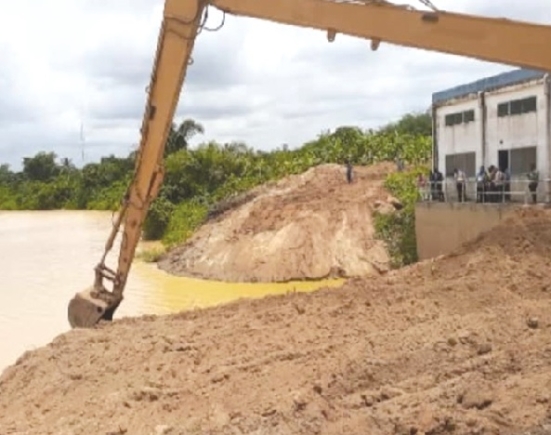
There is a lot of silt in the Sekyere Hemang intake plant.
He added that the issue was being made worse by farming operations close to bodies of water.
He noted that deforestation and soil erosion were contributing to increased sedimentation in rivers and reservoirs, and that farmers’ increased use of pesticides, fertilizers, and agrochemicals was poisoning water supplies.
Because of nutrient contamination, we are witnessing an increase in algal blooms in water sources. He cautioned that the current practice of farming dangerously near water bodies is hastening the deterioration of our water quality.
Water resources are declining.
In his research of the Central Region’s water supply, Dr. Ato Quansah, a former Central Regional Director of the Community Water and Sanitation Agency, noted that while some areas relied on groundwater, the majority of the region was dependent on surface water.
He claimed that while the human population had doubled over the previous 50 years, fresh water availability had decreased by half.
“There was twice as much fresh water available when you were 10 years old as there is now if you are 60 years old today.” He added that it was becoming more and more challenging to serve everyone because water supplies had decreased, and demand had increased as a result of the fast population rise.
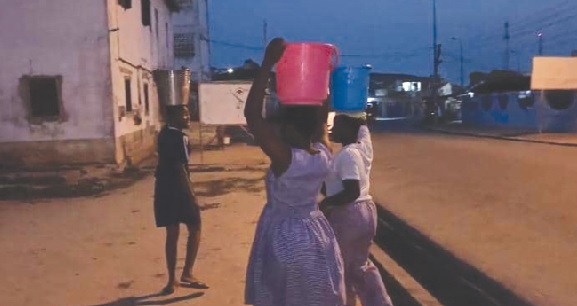
Residents are compelled to look for water even at night.
He also cautioned that the nation was in “a very dire situation” since water quality has declined on all significant metrics, including chemical and physical ones.
Immediate conservation actions
Dr. Quansah emphasized that water conservation was now a need rather than an option in light of the concerning trends.
In order to prevent serious water shortages in the near future, he advised people, organizations, and enterprises to embrace sustainable water usage practices.
The only option left to us in this dire circumstance is water conservation. We run the risk of experiencing an even more serious water problem in the years to come if we don’t act now,” he said.
By avoiding unnecessary use, exposing illicit connections, and supporting laws that support water sustainability, he urged the public to actively participate in the protection of water resources.
His comments emphasized how vital it is for everyone to work together to protect water resources for coming generations.
Locals
Residents who were interviewed by the Daily Graphic had differing views about the GWL’s services.
Some claimed they were content with their bills and demanded a consistent supply of water, while others claimed their invoices did not accurately reflect the water they were given.
Maame Adwoa, a resident of Greenhill in Cape Coast, claimed that although her tap had not produced water for months, she had lately received a bill from GWL for GH¢1,000.
“If we are billed for water we have not used, how do we pay such bills?” she said.
She stated she had been using well water for months, but now she had a big bill to pay. She also said she would ask the GWL headquarters for an explanation.
Daniel Tetteh, another Greenhill homeowner in Cape Coast, stated that he was happy with the GWL’s bills and services thus far and that all he needed was for the taps to run consistently.
Eva Adjei, a Yamoransa resident, claimed that the water supply had been inconsistent in recent months.
“It goes off for a week and comes for two days, yet we are billed regularly, and it’s difficult to pay for what you have not used,” she stated.
According to Ms. Adjei, GWL sends customers monthly bills for water that was allegedly used even though the water supply was erratic.
“For fear of our lines being disconnected, we pay the bills even though we know we have not consumed that much,” she stated.
Evelyn Wilson, another resident of Mempeasem on Cape Coast, reported that her water supply had been consistent and that she was pleased with the GWL services and bills.
However, she voiced concerns about quality and urged action to raise it even more.
visit itrotronews everyday for updates